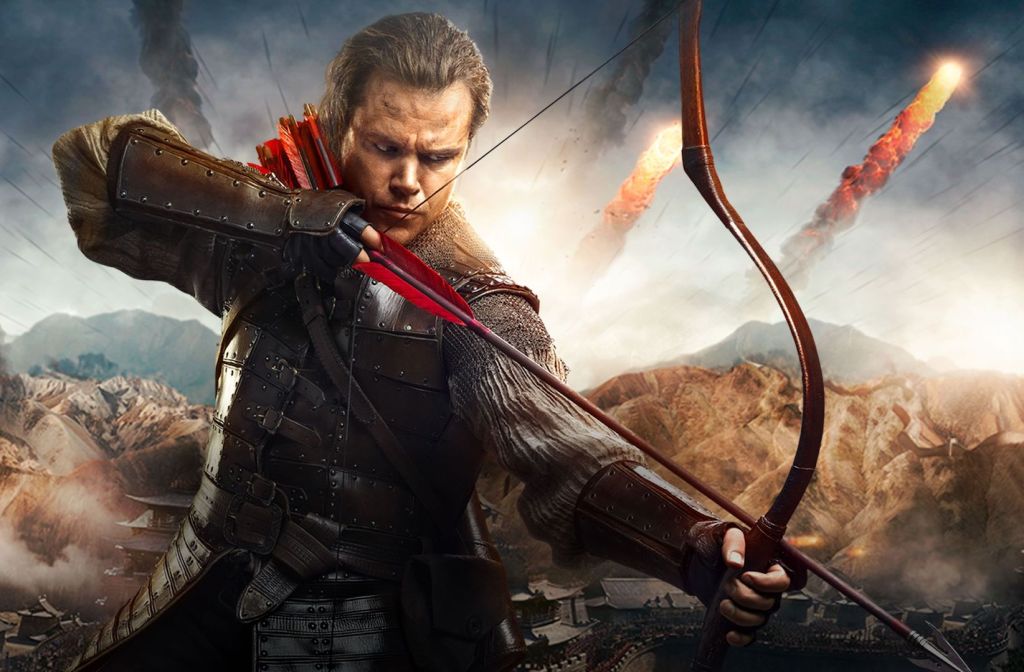
An interview for Empire with Zhang Yimou a couple of months in advance of the release of The Great Wall (which nobody had yet seen at the time). This was for a preview feature in the print magazine, but the whole transcript follows. On-the-spot translation was provided by Frank Lin.
Has anybody seen the whole movie yet?
We’re in post-production right now. The only people who’ve seen it so far are the people working on it. We did do some audience testing a while back. That went well. I’ve never gone through that process before and it was very informative and fun to understand what the American audience are interested in.
What about this project made you want to make it your first international film?
About three years ago I read the script and was very fascinated with the idea of fighting monsters on the Great Wall. My schedule opened up and I decided to do it.
It’s a very Western writing team. Did they get it right, culturally?
The script had been in development for about eight years before I read it, and I thought there were several things that needed correcting, culturally and historically. Even though it’s a monster movie, we’ve got to get the basics right. So as a filmmaker from China I was able to help them fix all the things I thought needed to be addressed. We spent about a year re-writing the script.
What was the thinking behind actually giving it to a Chinese director?
I’m not quite sure why the studio made that decision, but I’m guessing that it’s because of the rise of the Chinese film market in the world. It’s now second only to the US. I understand the culture really well, so it might have made sense for them, financially, to hire a Chinese director to collaborate on something like this. However, for them to hire somebody who doesn’t speak English at all to direct an English film is a pretty big gamble for them!
Is it a Chinese film with Hollywood involvement, or a Hollywood film with Chinese involvement?
Creatively, not financially, from my perspective this is a Chinese movie that invited Hollywood actors to be in it. It’s a pure Chinese story that happens to have Western characters.
Is it an original story or is it based in an older legend?
It’s a purely original story. When I first read the script… The Great Wall has existed in China for thousands of years, and it took a Western company and writers to look at it and say, ‘Let’s fight some monsters off it!’ It’s incredible that nobody had thought of that before.
Is that because it might be seen as disrespectful?
First of all the Great Wall is a great cultural symbol for China: in ancient Chinese history it’s a symbol of protection. It protects China from foreign invasion. In more recent years it’s come to symbolise the Chinese spirit: the willingness to work hard and create something great. Even in the National Anthem it says, ‘We’ve got to use our blood and sweat to build the new Great Wall’. Everything about the Great Wall is taken very seriously by the Chinese, so nobody ever thought to do something fantastical on something so serious. But it’s not insulting at all: it’s just something that’s never been thought about. Also it’s very hard to build the Great Wall for a movie. You can’t shoot on the real thing. It’s protected. Building another one is very expensive.
How much did you have to build?
We went to Qingdao, a coastal city in China, and built three walls running 200 metres. We had a high wall, a medium wall and a low wall, for different parts of the film. It’s very impressive seeing the Great Wall being built again!
Is it true that this is the biggest Chinese film in history?
Yes, there are a lot of firsts on this film. It’s the most expensive film ever made in China, and it’s the most that Hollywood has ever been involved in a Chinese production. It’s probably the biggest film Hollywood has ever done where they hired a director that doesn’t speak English. Also, it’s my first English film. Ten years ago I thought maybe I’d make a movie in Hollywood, but I never thought it would be about monsters on the Great Wall.
Does the size of it and all those firsts make it intimidating?
Not really, because it’s set in China and made in China, so I felt really at home. The only thing that I felt was challenging was designing a movie for a world audience. I’ve only made movies for a Chinese audience before, so I’ve never had to worry about what other audiences will think. It’s interesting, even down to single line, I have to figure out whether everyone in the world can understand the meaning.
Will this film play very differently in the two countries, even though it’s the same film?
I think it’ll play differently to different cultures. We have a saying in China, 100 different people will have 100 different takes. But my goal is to make it exciting for the young audience. I want the youth of the world to come and watch this movie, but at the same time, I think the plots of a lot of mainstream blockbusters are often much too simple. I don’t want to make it boring for the audience and just make a movie for kids, so I wanted an interesting plot.
Is it the same cut everywhere?
Currently yes: the plan is to have one version for everybody.
What was different for you about making this film, apart from the test audience?
I learned a lot from audience testing: mainly plot points and clarification of meaning behind scenes. Western audiences won’t understand certain things that a Chinese audience will get immediately, so I had to change my way of telling stories so they can be understood in a worldwide arena. My main goal is for Matt Damon… his character is a mercenary who shows up in China and fights alongside Chinese soldiers, and is eventually moved by their willingness to sacrifice and their dedication to a good cause. That changes his perspective and his world view. That was very important to me and I wanted to make sure that was understood.
Is it ‘a Matt Damon movie’ or more of an ensemble?
It’s a combination of both. It’s a single person’s story plus an ensemble story. It’s really the clash of Western culture and the Eastern group mentality. The whole group of soldiers are willing to sacrifice themselves to defend the wall, and Matt Damon is a Westerner with a Western perspective of individualism and self-preservation. He doesn’t want to risk his life unless it’s worth it for him. So there are clashes between those perspectives, which sums up the movie.
Did the size of the project mean that it needed a Matt Damon?
Absolutely. A big budget film like this needed someone like him for a worldwide audience. Unfortunately, even the biggest Chinese stars can’t break a film out to a worldwide audience. In addition, Matt is extremely talented and well known throughout the world, why not seize the opportunity to work with him?
What was that working relationship like, given the language barrier?
I had actually reached out to Matt when I was making Flowers of War, and he couldn’t do it because of a scheduling conflict. So I’d wanted to work with him for a long time. Working with him was actually quite easy because there’s an unspoken understanding. We do have translators, but a lot of times we could understand each other. He’s a great screenwriter himself, so if I thought lines weren’t quite right yet, he would come up with six alternatives. He’s very collaborative, very low key, and he’s a great guy. Everybody loves him on set.
Was it an entirely Chinese crew?
Two-thirds were Westerners and the rest were Chinese. And the Western crew came from 20 countries. It was a truly international production. It was great to see so many cultures coming together. But the most important thing was that they were all professional filmmakers.
What was it about Matt Damon that made you want to work with him?
I’ve seen a lot of his films and always been a fan of his. But I specifically like how naturalistic and low key his performances are. He’s very real. When I was making Flowers of War I asked Steven Spielberg for recommendations, and he recommended Matt. When he couldn’t do it we ended up with Christian Bale. Then for this film, fighting monsters on the Wall, to make it real I wanted somebody naturalistic.
That’s interesting: you’re looking for naturalistic when your films are often in a very heightened reality. What’s the tone of this film?
There is a style imposed on this movie. There are so many superhero films now, and I’m getting tired of that: this endless run of films with crazy powers who can do anything they want. That’s becoming less interesting to me. So I really wanted to approach this differently. Of course it’s a fantasy movie about fighting monsters, but apart from that I wanted it to be as realistic as possible. These soldiers don’t have superpowers. They have to figure things out and use their intelligence, and figure out how to fight these monsters with strategy and their technology. And the monsters are intelligent: they can strategise as well.
What actually are the monsters? Is that a secret?
No, not at all. It’s called Tao Ti, and it’s based in ancient historical Chinese fiction. Tao Ti is one of the earliest totem symbols of China, before even the dragon. You’ll see the face of the Tao Ti on ancient bronze vessels. It’s existed in China for a long time. It represented greed and ravenousness. You only see its face represented usually, because the story goes that it was so greedy and ravenous it ate its own body. In modern Chinese it’s used to describe epicurianism and great feasts and banquets.
You mentioned you’re tiring of superhero films: does that mean an end to the more colourful, acrobatic action we’ve seen from you before?
I approach it from a more realistic angle, but I can’t stay away from colour and very well choreographed action sequences. That’s what I’m known for. I can’t deviate from that. The difference this time is, the way the Chinese fight in this film is with ancient Chinese technology and weaponry and gunpowder, so the battles are fought well. We have five different troops – corps – with five different colours. We have a scene with Matt on the wall analysing what colour goes with what troop, and what colour does what. He’s almost analysing the way I use colour.
Has this given you a taste for English language filmmaking? Will we see you in Hollywood making Die Hard 6?
[Laughs] Not at all. After making this movie I realise how complicated it is to make a Hollywood blockbuster. It takes twice as much time as I’d usually take in China. A lot of it is the translating and communication. This hasn’t made me love making films in China any less. I love making films in China and I’ll continue doing that. But I look at it as a learning experience. By working with different collaborators I learn different things, and I learned things on this that I wouldn’t have learned working with my usual crew. I can take all that to my next film.

 Owen Williams