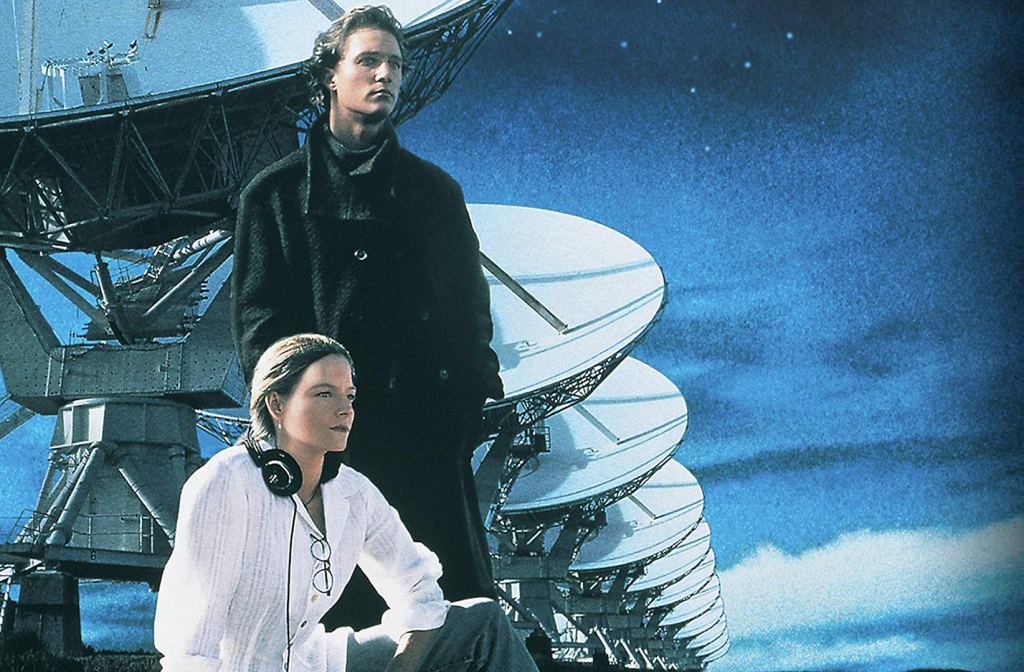
I wrote a feature for Empire on quirky movie credits, and what follows is the text of a long email sent to me by Stefan Dechant. Stefan is a production designer, art director and concept artist who’s worked with the Coen Brothers, Guillermo Del Toro, James Cameron, Steven Spielberg, Tim Burton, Sam Raimi and many others. But on Robert Zemeckis’ Contact, his credit was ‘Fourth Dimensional Consultant’. I got in touch to ask him exactly what that meant, and this was his incredibly generous response.
So here is the story behind the credit ‘Fourth Dimensional Consultant’. It’s one of my favourite credits.
There were three of us listed as Fourth Dimensional Consultants on Contact: Rick Carter, John Bell and myself. Basically, we were part time visual consultants who for various reasons were not able to work on the project full time through the art department. Rick was production designing the sequel to Jurassic Park; I was working for Rick as an illustrator; and I believe John was in San Jose working for a video game company. The Fourth Dimension of the title I believe refers to the imagination rather than any fourth spatial dimension, or to time (which really is the fourth dimension.)
Rick and John had been connected with Bob Zemeckis since Back to the Future 2. Rick Carter had designed all Bob’s films since BTTF2, and John had been Rick’s art director on Jurassic Park and worked quite closely with Rick on BTTF2 with the design of the future sets and vehicles. John is also an incredible concept designer and illustrator. My connection with Zemeckis’ Contact came from my work on the George Miller version. I had been working in the Contact art department for about nine months when George Miller was slated to direct the project. The art department on the George Miller version of the show had been quite involved in story meetings with George and Linda Obst, as well as brainstorming sessions with the theoretical physicist Kip Thorn and [Contact‘s original author] Carl Sagan. In those meetings we would discuss amongst other things, how a higher intelligent life might send encoded messages layered in radio signals; what the machine that takes Ellie (the Jodie Foster character) to the centre of the galaxy might look like; how it would be constructed; and how it would travel through these wormholes and what traveling through a wormhole might look like. Scientific accuracy was extremely important in those meetings and we had quite a few of them.
The show itself never seemed to progress and then, I think around October of 1995, George and Warner Brothers parted ways. Somehow during those meetings I made some kind of impression with our executive producer, Joan Bradshaw, and when George left the project and it looked like Zemeckis was going to take over, she championed me with Bob’s producer Steve Starkey. I can’t recall how many months had passed until the project went back up under Bob, but when it did I was working on The Lost World for Rick.
When Contact did start back up, Zemeckis and Steve Starkey set up their own brainstorming sessions, but these sessions were more cinematically and story driven and less scientifically driven than they had been with George Miller. As I mentioned before, Rick and I were working on The Lost World, but were invited to these afternoon get togethers which also included John Bell, Ed Verreaux the production designer, Steve Burg his concept designer, Joan Bradshaw the executive producer, Steve Boyd and Rick Porras who were associate producers, and Ken Ralston the visual effect supervisor and his producer from Sony Imageworks, Debbie Denise. There was even one session that Ralph McQuarrie sat in on. At that time, Bob and Steve’s bungalows were just a five-minute walk away from the Amblin bungalows on the Universal lot. So twice a week Rick and I would head over to these brainstorming sessions.
Rick had hired me right out of the University of Cincinnati, sight unseen on Jurassic Park, based on John Bell’s recommendation. I had been an intern in the ILM art department under John. Rick was and still is an incredible mentor. (I just finished up Sucker Punch working as one of his art directors.) Rick gave me the best advice going into those meetings. He said, ‘Only propose an idea if you know it’s an idea that Bob can build off of, and remember: it’s your idea until you present it, and then it’s Bob’s idea.’
Those two thoughts have been my guiding philosophy for my entire career; meaning if you’re not bringing an idea to the table that the director can take and mould into his own, then you’re not bringing anything to the table. You’re just shooting off steam, and you’re no use to anyone. In those meetings you were trying to pitch an idea to Bob that he could knock out of the ball park, and you knew you were on to something when Bob would say, ‘Well that’s great, but what I thought you were going to say was…’ and he would take this kernel of an idea you might have and blow it up one thousand fold and take it in a completely different direction. Knowing that you sparked something in his imagination that he could really run with was the best.
Those meetings were great. Bob might start the meeting with some preconceived cinematic rule, such as, ‘We never see the completed machine until then end of the movie when Ellie gets ready to enter it on her wormhole trip.’ In that case, after Bob had said that, Ed Verreaux showed Bob a series of illustrations of the machine under construction at Cape Canaveral that he had Steve Berg working on. Bob looked at the artwork, thought it was cool and then announced something to the effect, ‘Okay screw that. We’ll see the machine in its entirety whenever we want to.’
I believe the look of the machine was something that Rick and Ed came up with; the idea of moving rings around a nucleus being reflective of the universe at both the atomic and cosmic level. John Bell came up with the idea that the environment in which Ellie meets her father would be like a virtual forced perspective set, so that Ellie could reach out and touch and manipulate clouds and trees way in the distance.
The opening shot of Contact – the massive powers of ten shot which started floating above the earth and pulling back out to the far reaches of the universe and continues pulling back out of the light reflected in young Ellie’s eye – was another idea that came out of those early meetings. It was Bob’s idea. The concept of moving between the infinite and Ellie was something which was a key concept discussed quite a bit in those first few meetings
I can’t remember anything of any value that I contributed in those early meetings. We would have those meetings and then I was supposed to create artwork based on what was discussed. I was supposed to do that in the evenings after I had completed my day on The Lost World and bring that work to the next brainstorming session. The problem was that I felt so swamped with The Lost World I wasn’t contributing that much if anything to Contact. So after about three weeks I let everyone know that I could only focus on one show and that had to be The Lost World.
I believe John Bell continued for quite some time and contributed a fair bit of work on the show, I believe he worked on Ellie’s space suit, a variety of props, dressing and equipment and I believe Rick was involved every now and then, but his primary focus was The Lost World.
That was about it for me with Contact until about six or seven months later. I had finished The Lost World and Ed Verreaux called me and asked if I would be interested in storyboarding Ellie’s trip through the wormhole for Bob. Ellie’s trip had been boarded by a variety of other artists including John Bell, but it had never gelled into a completed sequence. I came in and under Bob’s direction reworked some of those previous attempts as well as added some of my own ideas into the sequence. One of those ideas was to have Ellie fracture and encounter versions of herself from the past and the future. It was an idea I came across while reading Alfred Bester’s novel The Stars My Destination, in which a similar situation happens to the protagonist Gully Foyle. My original idea was that it would be two Ellies in the pod at the same time but only the Ellie in the present would be aware of the Ellies of the past or future. In the film, Bob presents a slightly different version. I guess that would be the best example of it’s-your-idea-until-it’s-Bob’s. There was something in that idea he liked, but what he thought I was going to say was just a little bit different and better.
I worked on that sequence for two weeks and then was invited to stay on the set while we were shooting the sequence. Steve Starkey thought it would be good for me to continue to be a part of the process. That was a very generous gift from Steve, as was the credit Fourth Dimensional Consultant. I never thought I should or would be credited on that film, but to be credited with John and Rick, both of whom had opened the door for me into the industry and both of whom were exceptionally important mentors, was pretty great.
So that’s the long and short of it. I hope this works for you. If not, I completely understand. I hope it’s not too much of a disappointment that there really is no fourth dimensional consulting going on!

 Owen Williams